
Heavy-duty hydraulic breakers have become essential tools in modern mining and infrastructure construction. As global demand for minerals, transportation networks, and large-scale urban development grows, contractors rely on powerful breaker attachments to handle tough materials such as reinforced concrete, granite, and hard rock formations.
From quarry operations to highway construction and tunnel excavation, hydraulic breakers help improve productivity, reduce operational costs, and increase efficiency across demanding projects.
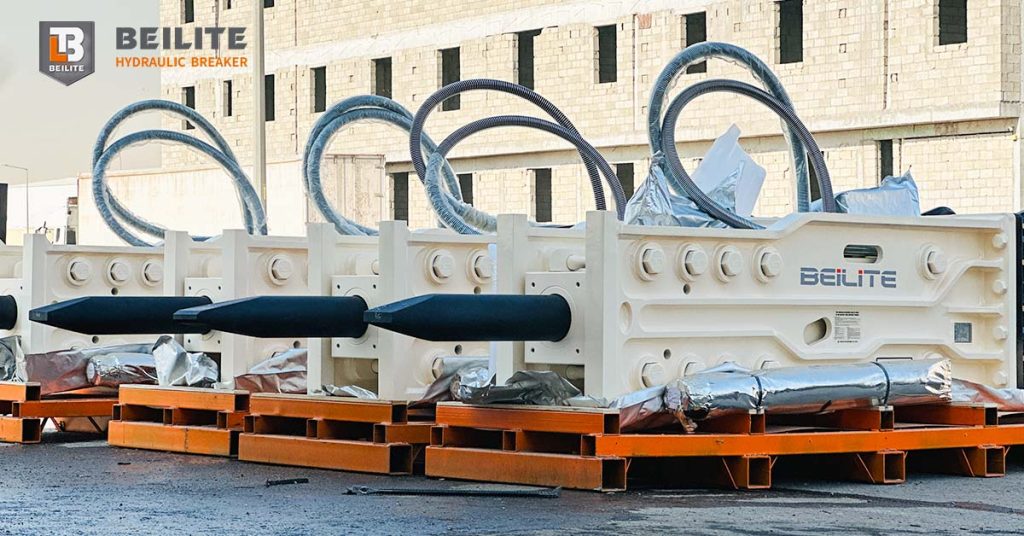
What Are Heavy-Duty Hydraulic Breakers?
Heavy-duty hydraulic breakers are excavator-mounted attachments designed to deliver high-impact energy for breaking rock, concrete, and asphalt. Using hydraulic pressure from the carrier machine, the breaker converts energy into repeated hammering force through a piston and chisel system.
These excavator breakers are typically installed on large excavators from leading manufacturers such as Caterpillar, Komatsu, Sany, Case and Volvo Construction Equipment, ensuring compatibility across a wide range of heavy machinery used in mining and infrastructure projects.
Heavy-class hydraulic breakers are engineered with reinforced structures, advanced shock absorption, and wear-resistant materials to withstand continuous heavy operation.
Key Hydraulic Hammers Applications in Mining and Infrastructure
Heavy-duty hydraulic breakers play a critical role in multiple sectors where powerful rock and concrete breaking is required.
1. Mining Operations
Mining sites require efficient rock fragmentation to access valuable minerals and maintain productivity. Hydraulic breakers are widely used for:
- Primary rock breaking in open-pit mines
- Secondary rock breaking after blasting
- Oversized boulder reduction
- Trenching and ore extraction
Their high impact energy allows operators to break hard rock without relying solely on explosives, improving safety and operational control.
2. Quarrying and Aggregate Production
Quarries use hydraulic breakers to process limestone, granite, and other aggregates used in construction. Breakers help:
- Reduce large rocks into manageable sizes
- Increase material processing efficiency
- Maintain continuous production flow
- Minimize downtime caused by oversized materials
This makes them essential for producing construction aggregates used in roads, bridges, and buildings.
3. Infrastructure Construction
Large infrastructure projects require extensive excavation and demolition. Hydraulic breakers are commonly used in:
- Highway and railway construction
- Bridge demolition and foundation work
- Tunnel and metro excavation
- Dam and port construction
They enable precise demolition and rock breaking, helping contractors meet strict project timelines.
4. Urban and Industrial Demolition
Heavy breakers are also used to demolish industrial facilities, old buildings, and reinforced concrete structures. Their controlled impact reduces vibration and improves safety compared to traditional demolition methods.
Types of Heavy-Duty Hydraulic Breakers
Heavy-duty breakers are generally categorized into three main structural types:
I. Side Type Excavator Breakers
Known for simple structure and easy maintenance. Suitable for mining and quarry work requiring strong impact force.
II. Top Type Hydraulic Rock Breakers
Offer high efficiency and easy servicing. Commonly used in large infrastructure and excavation projects.
III. Box (Silenced) Type Hydraulic Breakers
Enclosed design reduces noise and vibration. Ideal for urban construction and sensitive environments.
Each type is designed to meet specific operational needs depending on project scale and working conditions.
Benefits of Using Heavy-Duty Hydraulic Breakers
1. High Productivity
Hydraulic breakers significantly improve rock breaking and demolition speed. Their strong impact energy allows contractors to complete tasks faster and reduce project timelines.
2. Durability and Reliability
Heavy-duty breakers are built with high-strength steel and wear-resistant components. This ensures long service life even in harsh mining and construction environments.
3. Cost Efficiency
By reducing manual labor, explosives usage, and additional equipment needs, hydraulic breakers help lower operational costs while increasing efficiency.
4. Versatility
Hydraulic breakers can be used across various industries, including mining, construction, quarrying, and demolition. Their compatibility with different excavator sizes enhances jobsite flexibility.
5. Improved Safety
Using hydraulic breakers reduces reliance on blasting and manual demolition methods. This improves safety for workers and minimizes risk on job sites.
Choose the Right Hydraulic Breaker
Selecting the correct breaker for mining or infrastructure work requires careful evaluation of several factors:
- Excavator weight and hydraulic capacity
- Material hardness and density
- Required impact energy
- Working environment (urban, quarry, mining)
- Maintenance and spare parts availability
Proper matching between excavator and breaker ensures optimal performance, reduced wear, and longer equipment lifespan.
Future Trends in Heavy-Duty Breakers
Technological advancements are transforming hydraulic breaker performance. Modern breakers now include:
- Automatic lubrication systems
- Energy recovery technology
- Noise and vibration reduction features
- Smart monitoring systems for performance tracking
These innovations help contractors improve efficiency, reduce downtime, and extend equipment service life.
Summary
Heavy-duty hydraulic breakers are indispensable for mining and infrastructure construction projects worldwide. Their ability to deliver powerful, precise, and efficient rock and concrete breaking makes them essential for modern heavy equipment operations.
As global infrastructure and mining activities continue to expand, demand for reliable and high-performance hydraulic breakers will only grow. Choosing the right heavy-duty breaker ensures maximum productivity, durability, and long-term value for contractors working in demanding environments.
FAQs
1. What industries use heavy-duty hydraulic breakers most?
Mining, quarrying, infrastructure construction, tunneling, and large-scale demolition projects are the main industries that rely on heavy-duty hydraulic breakers.
2. How long do heavy hydraulic breakers last?
With proper maintenance and correct usage, heavy-duty hydraulic breakers can operate for many years, even under continuous high-impact conditions.
3. Can hydraulic breakers replace blasting in mining?
In some applications, hydraulic breakers can reduce or replace blasting, especially for secondary rock breaking and controlled excavation where precision and safety are required.
Beilite Machinery Co., Ltd.
+86 183 5766 9906
+966 50 019 8571
+6282321982255
 English
  Arabic